Custom Software Development
Built Around Your Workflow
Off-the-shelf software makes you adapt your business to its limits. We build the reverse — software shaped exactly around how your team actually works, so the tool disappears and the work just moves faster.
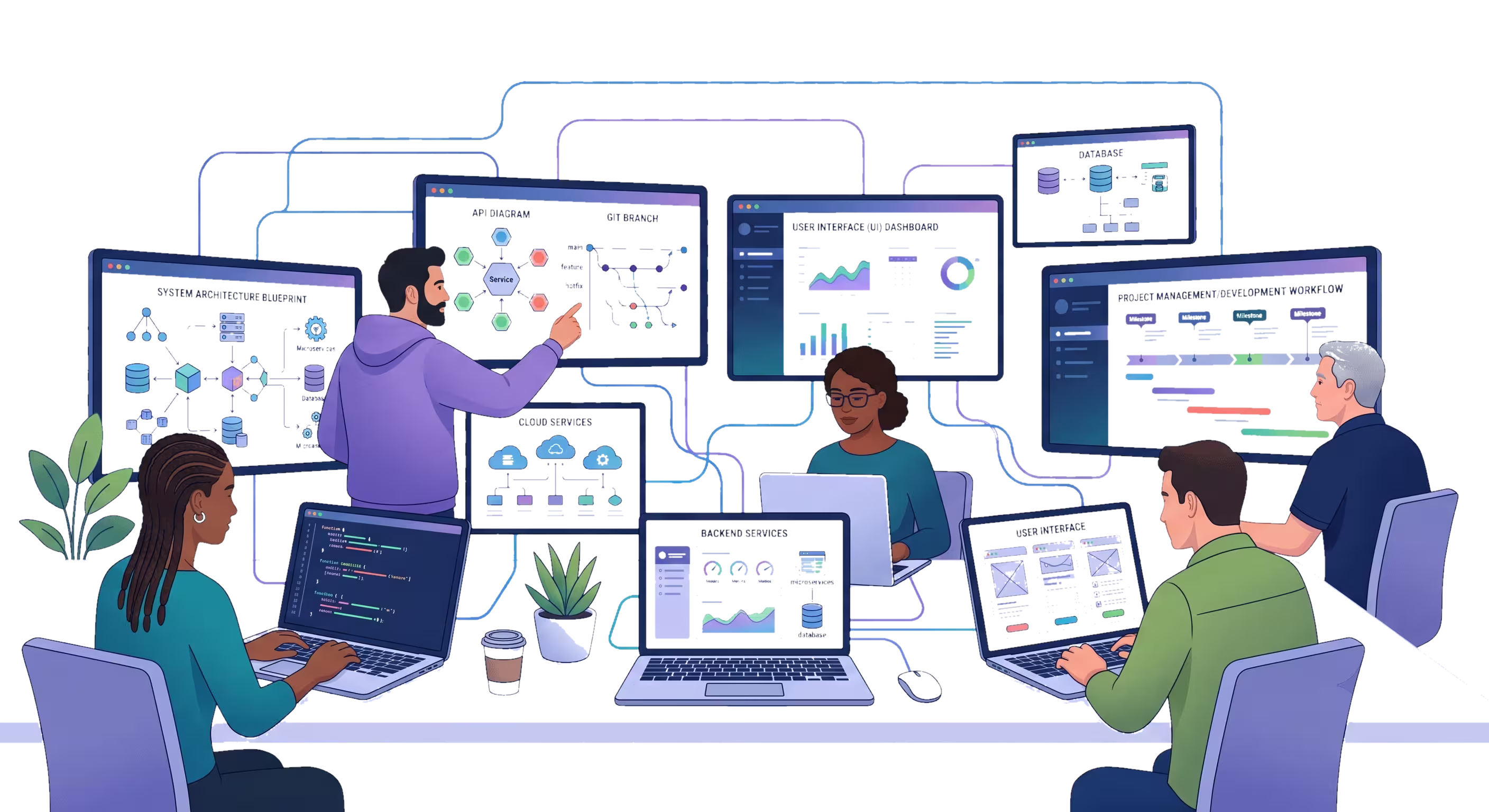
Service Overview
Everything you need to know about how this engagement creates value for your organization.
What is it?
Software engineered from your actual processes and constraints — not configured from a template that assumes a generic business.
Who needs it?
Businesses whose growth is capped by manual workarounds, spreadsheet chains, or off-the-shelf tools that almost fit but never quite do.
Business Value
Turns the workflow your team already runs into a system that runs it faster, with fewer errors, and without a recurring per-seat license bill.
Key Benefits
- Software shaped to your process, not the other way around
- One owned system instead of five stitched-together tools
- No per-seat license costs that scale against you as you grow
- A durable asset that adds to your company's valuation
Why Is Generic Software Quietly Taxing Your Operations?
Most businesses don't notice the cost of an ill-fitting tool — it shows up as small workarounds, repeated across every team, every day, for years.
Your team builds workarounds for gaps in the tool
A spreadsheet bridges what the software can't do, a shared doc tracks what the CRM doesn't capture — and each patch becomes one more thing that can break silently.
You're paying per seat for features you don't use
Generic platforms bundle dozens of modules built for a different business than yours, and the license cost climbs with headcount regardless of what you actually touch.
Data lives in five places that don't talk to each other
Orders in one system, inventory in another, customer records in a third — so a simple question means manually reconciling three exports before anyone gets an answer.
Every process change means a support ticket
A vendor's roadmap decides what your software can do next, not your business — so an urgent operational change waits in a queue you don't control.
The tool doesn't scale the way your business does
What worked at ten staff starts to buckle at fifty — approval chains, reporting, and permissions were never designed for your current scale.
You own nothing at the end of it
Years of subscription payments leave you with no asset — cancel the plan and the operational muscle memory it encoded disappears with it.
What Purpose-Built Software Actually Changes?
A system built around your real process removes friction at the exact points your team feels it daily — not the points a vendor's roadmap prioritized.
Work moves at the speed of the process, not the tool
Screens and workflows match how your team actually operates, so tasks that took workarounds now happen in the software directly — faster, with fewer handoffs.
One system replaces a stack of disconnected tools
Data that used to live in five spreadsheets and three logins now lives in one place, so every report and every answer comes from a single source of truth.
It plugs into what you already run
Payment gateways, accounting software, and existing databases connect through clean APIs, so the new system extends your operations instead of replacing them wholesale.
You control the roadmap, not a vendor
Every future change — a new approval rule, a new report, a new integration — is a conversation with your own engineering partner, not a feature request in a public queue.
Where Does the Return Actually Come From?
The return on custom software shows up in hours reclaimed and licenses no longer paid — both measurable against your current baseline.
Lower long-term cost than compounding SaaS subscriptions
you pay once to build the asset instead of forever to rent a partial fit.
Fewer manual reconciliation hours
one system means data is entered once and trusted everywhere, instead of re-typed across disconnected tools.
Faster process changes
an operational fix ships in days through your own engineering partner, not months through a vendor's backlog.
Reduced error rates
validation and business rules are built into the workflow itself, catching mistakes before they become costly.
An asset that compounds
the system gets more valuable as it's extended, unlike a subscription that resets to zero the moment you cancel it.
How Does the Engagement Actually Run?
The same disciplined process behind every project, applied to this one.
Process & Systems Audit
We map exactly how your team works today — the tools, the workarounds, the handoffs — before proposing a single screen.
Architecture & Scope Definition
We define the system's structure, data model, and integrations, scoped against your real constraints, not a generic feature list.
Iterative Design & Build
We build in reviewable sprints, with working software you can click through and correct at every stage — not a single reveal at the end.
Integration & Data Migration
Existing records and third-party tools are connected and migrated carefully, so day one runs on real data, not an empty system.
Launch, Training & Support
We train your team, monitor the first weeks of real usage closely, and stay on to extend the system as your process evolves.
What Actually Happens During the Build
No black box. Here's what you're involved in, and what you walk away owning.
- A documented process map before any code is written, so scope is agreed, not assumed
- A working staging environment you can test against at every milestone
- Source code and infrastructure you own outright, with no vendor lock-in
- Role-based access control scoped to how your team is actually structured
- API documentation for every integration point, for your team or ours to extend later
- A handover package — documentation, admin training, and a support plan for what comes next
What's a Realistic Timeline?
Scoped ranges, not vague promises — the exact plan is confirmed after discovery.
Discovery & Architecture
1–2 weeksProcess audit, data modeling, and a scoped technical plan.
Core Build
4–10 weeksThe primary system, built and reviewed in shippable increments.
Integration & Migration
1–3 weeksConnecting existing tools and moving historical data in safely.
UAT & Launch
1–2 weeksStructured testing against real scenarios, staff training, and go-live.
What Technology Is Behind It?
We pick the right tool for the outcome — not the newest one for its own sake.
Backend
Frontend
Integration
Infrastructure
What Results Have We Delivered in Custom Software Development?
Real outcomes from custom software development engagements, not manufactured claims.
A regional logistics operator
Dispatch, driver assignments, and delivery confirmations were coordinated across phone calls and a shared spreadsheet, with no record either side could trust in a dispute.
We built a dispatch management system tailored to their exact routing rules, with a driver mobile view for real-time delivery confirmation.
Dispatch decisions and delivery records now live in one auditable system, replacing phone-call coordination with a process the whole team can see and trust.
Related Services
Capabilities that pair naturally with this one.
Related Solutions
Purpose-built systems that solve adjacent problems.
Who This Is Built For
See how this looks in practice for a specific industry.
Questions About Custom Software Development
The practical details behind how we deliver this specific service.
Configuration bends your process to fit the platform's existing structure. Custom development starts from your process and builds the software to match it exactly — no compromises baked in from day one.
Ready to Stop Adapting Your Business to Someone Else's Software?
Tell us where the workarounds are. We'll show you exactly what a system built around your process would remove.